
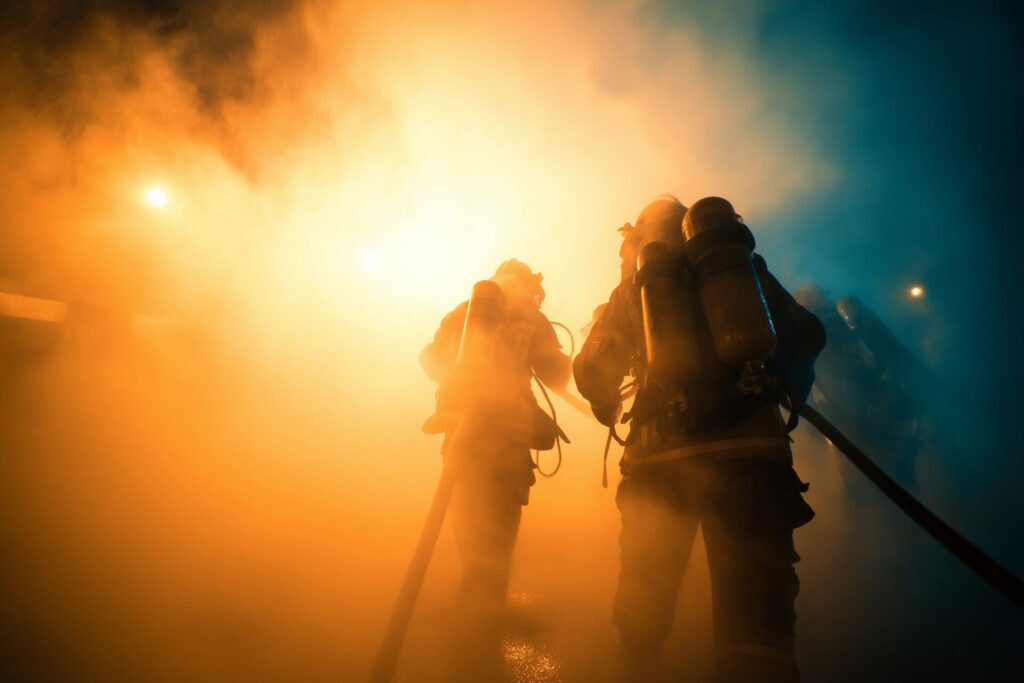
In wildland fires, many wildland firefighters talk about What is “invisible fire” and how is it fought? when they refer to that heat that cannot clearly be seen as flames, but still threatens their lives and influences every decision on the fireline.
Understanding invisible fire in wildland environments
We use the term invisible fire for situations in which the flame front is not clearly visible, but thermal radiation, hot gases and convection are already affecting the surroundings. This can happen due to very dense smoke, terrain that hides the front, or smouldering combustion in roots, peat and duff. For the wildland firefighter, the risk lies in believing there is still room to operate when, in reality, the fire is about to overrun their position.
Factors that contribute to invisible fire. What is “invisible fire”?
Invisible fire is reinforced in canyons, ravines and areas with a large amount of fine fuels, where heat builds up and is channelled. Wind, sudden changes in direction and the alignment of slope–wind–fuel can create a dangerous “microclimate”. Time of day also plays a role: in the afternoon, when the air is more unstable, heat can move quickly even when flames are not clearly visible until the very last moment.
Tactics to fight it safely. What is “invisible fire” and how is it fought?
Fighting this type of fire requires tactical anticipation. Wildland firefighters must read the smoke column, the rate of spread and the behaviour of the vegetation. Entering areas without a clear view of the fire front, without defined escape routes or without identified safety zones means accepting an unacceptable level of risk. That is why there is so much emphasis on anchored work, the construction of secure control lines and the use of lookouts observing the fire from higher, safer vantage points.
Self-protection and safety culture in the face of invisible fire
When invisible fire turns into a full thermal envelope, self-protection makes the difference. Vehicles equipped with external protection systems, collective shelters for crews and thermal protection elements increase the probability of survival in an entrapment. However, everything starts earlier: with a culture in which the wildland firefighter self-regulates, knows how to say “we are not going in there”, and prioritises going home alive at the end of the shift over any tactical objective.
Did you enjoy our post What is “invisible fire” and how is it fought? Let us know in the comments.