
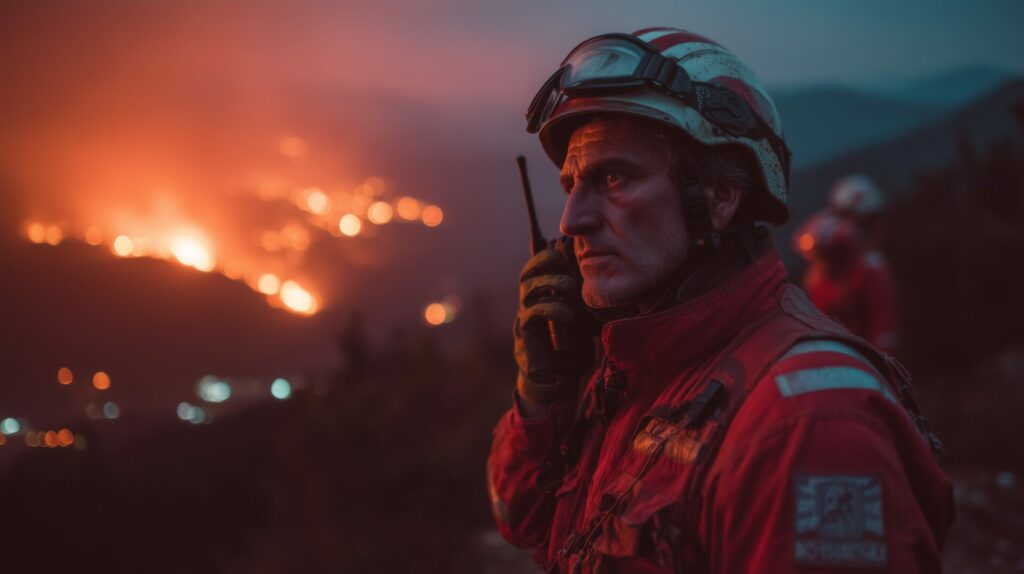
How to organize an Advanced Command Post. Organizing an Advanced Command Post (ACP) in a wildland fire is not just “setting up a tent and a table.” It means creating a command and control hub that enables fast, safe, and consistent decisions as fire behavior changes minute by minute. A well-structured ACP reduces uncertainty, improves coordination between resources, and above all protects crews in a dynamic, high-risk environment.
Below is a practical guide to plan, deploy, and operate an effective ACP in wildland fire suppression operations.
Selecting the ACP location
The site will define the ACP’s performance. Choose a point with clear access, enough space for maneuvering, and a feasible evacuation option if conditions worsen. It must be outside potential entrapment zones and away from chimneys, active drainages, and wind corridors.
Key criteria:
- Visibility of the operational area (without compromising safety).
- Reliable communications coverage or easy repeater deployment.
- Space to separate areas: command, logistics, briefing, and parking.
How to organize an Advanced Command Post: structure and roles
For the ACP to work, the structure must be simple, repeatable, and scalable. Assign roles immediately and avoid duplication. A typical setup includes:
- Incident Commander / Command: sets strategy and priorities.
- Operations: turns strategy into concrete missions.
- Planning: gathers intel, builds forecasts, and develops scenarios.
- Logistics: supply, relief, rest, fuel, water, tools.
- Safety: risk assessment, LCES, safety zones, and escape routes.
A disciplined ACP reduces communication errors and speeds up decision-making.
Communications and operational mapping
Communications are the ACP’s nervous system. Establish a communications plan: channels by division/sector, a command channel, a logistics channel, and emergency procedures. Confirm coverage and log issues.
In parallel, work with up-to-date operational mapping:
- Perimeter and hot spots.
- Safety zones and escape routes.
- Anchor points, tactical opportunities, and hazard areas.
- Weather forecast and wind shifts.
Information must be visible, shared, and version-controlled (which map is the current one and at what time).
How to organize an Advanced Command Post: briefing, control, and documentation
Routine is your ally. Run short, consistent briefings: objectives, fire situation, critical hazards, resource assignments, and withdrawal triggers. Repeat key points and confirm understanding.
Document decisions and timings:
- Assigned missions and responsible leaders.
- Strategy changes.
- Safety incidents.
- Resource check-in and check-out.
This improves traceability and helps you anticipate problems before they escalate.
Logistics, rest, and operational sustainability
An ACP fails when logistics fail. Ensure:
- Food/water and hydration point.
- Personnel relief and fatigue management.
- Fuel supply and basic maintenance.
- A rest area outside the fire’s influence.
Operational continuity depends on logistics as much as on tactics.
How to organize an Advanced Command Post with a safety-first approach
Safety is not a section; it’s the framework. Integrate LCES (Lookouts, Communications, Escape Routes, Safety Zones) into every decision and verify that each division has real escape routes and reachable safety zones.
In extreme-risk scenarios, self-protection becomes part of the system. Solutions like ISK Fire Survival are designed to increase survival probability during entrapment situations, and they can be considered within the broader safety approach when fire behavior becomes unpredictable.
A well-organized ACP brings clarity to chaos: prioritize safety, structure information, establish routines, and sustain logistics. When the fire changes, the command post must adapt faster.