Survival equipment for firefighters in LATAM
Survival equipment for firefighters in LATAM is no longer a secondary topic in wildfire operations. Across Latin America, wildfire behavior has become more extreme, faster, and less predictable. Extended droughts, complex topography, and limited access routes increase the risk of entrapment during suppression operations. In this context, survival equipment is not an optional resource, but a critical operational necessity for wildfire firefighters working on the fireline.
Wildland firefighters in LATAM often operate in vast rural areas, steep terrain, and regions with limited infrastructure. When fire behavior changes suddenly, escape routes can disappear in seconds. Survival equipment is designed precisely for those moments when suppression tactics fail and the priority becomes staying alive until conditions improve.
The reality of wildfire entrapments in LATAM
Latin America has seen a significant increase in high-intensity wildfires over the last decade. Firefighters frequently face long operational periods, extreme heat exposure, and limited logistical support. These conditions increase fatigue and reduce reaction time during critical moments.
Entrapments are rarely caused by a single mistake. They are usually the result of rapid wind shifts, slope-driven fire runs, or unexpected increases in fire intensity. In these scenarios, survival depends on having equipment specifically designed to resist radiant heat, convective heat, and direct flame contact.
This is where Survival equipment for firefighters in LATAM plays a decisive role. Properly designed systems allow crews to create temporary safety zones when evacuation is no longer possible.
Survival equipment for firefighters in LATAM and operational safety
Survival equipment must be engineered for real wildfire conditions, not theoretical scenarios. In LATAM, this means equipment capable of functioning in high temperatures, rugged terrain, and prolonged exposure to heat.
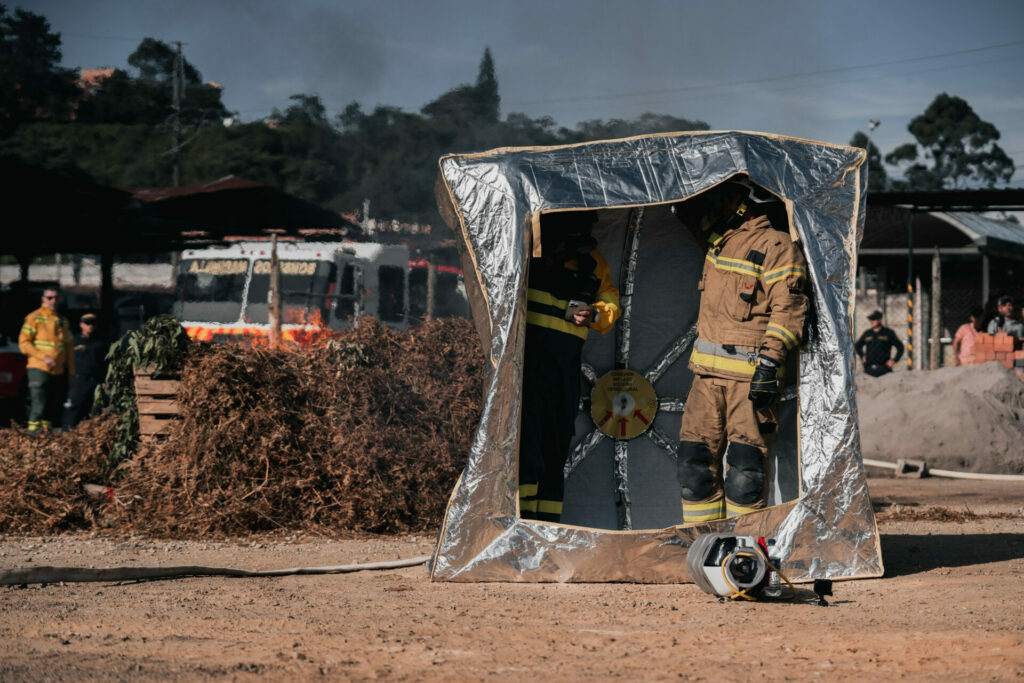
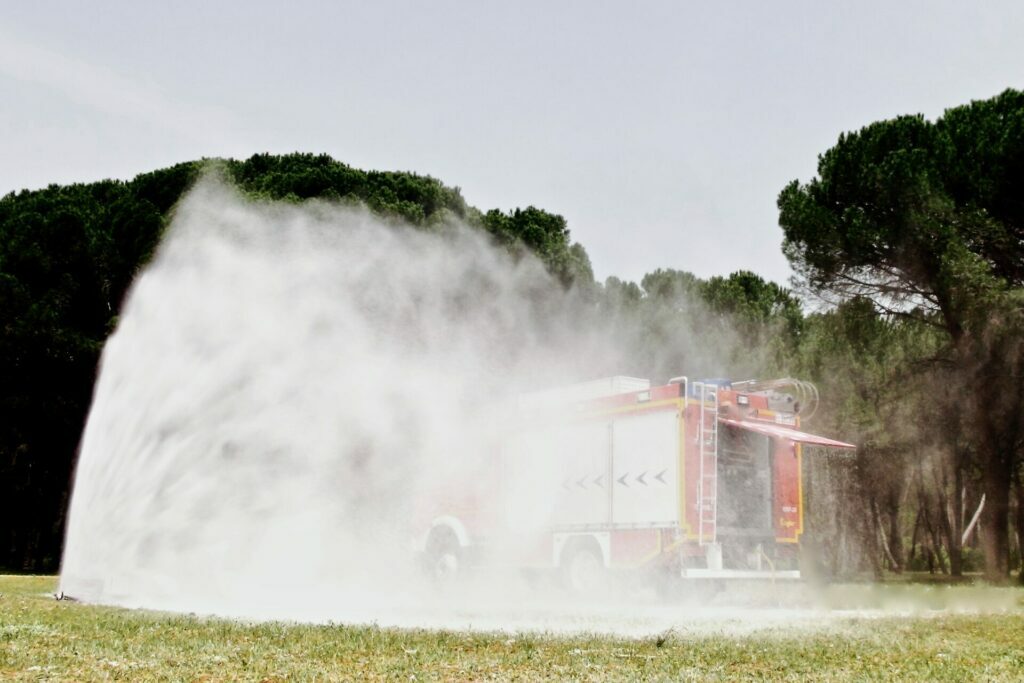
Key survival solutions include collective fire shelters, thermal protection systems for vehicles, and water-based self-protection devices. These systems are designed to reduce heat load and maintain survivable conditions for a limited time.
ISK Fire Survival develops survival solutions based on real wildfire entrapment scenarios. Their systems are designed to be deployed quickly, even under extreme stress and reduced visibility. Speed and simplicity are essential when seconds determine the outcome.
Vehicle-based survival systems in wildland operations
Wildfire vehicles often become the last refuge during entrapments. If a vehicle fails, survival chances decrease dramatically. Thermal curtains, underbody protection, and tire shielding help prevent vehicle ignition and maintain a survivable cabin environment.
In many LATAM regions, access tracks are narrow and surrounded by heavy fuels. Fire runs can overtake vehicles rapidly. Survival equipment that protects the vehicle allows firefighters to remain inside a controlled space while heat intensity peaks.
ISK integrates vehicle protection into a broader survival strategy, ensuring that equipment works together as a unified system rather than isolated components.
Survival equipment for firefighters in LATAM and collective protection
Collective protection is essential when crews cannot separate safely. Group survival shelters provide protection for multiple firefighters at once, maintaining team cohesion during critical incidents.
These shelters are designed to withstand extreme radiant heat and convective forces while limiting oxygen depletion. Proper sealing and certified fire-resistant materials are essential for maintaining survivable internal conditions.
ISK Fire Survival designs collective shelters that deploy rapidly and are compatible with wildfire operational protocols used across LATAM. This type of Survival equipment for firefighters in LATAM significantly increases survival probability during large fire overruns.
Training and integration of survival equipment
Survival equipment is only effective if firefighters are trained to use it correctly. Equipment must be integrated into standard operating procedures and practiced under realistic conditions.
Training focuses on rapid deployment, decision-making under pressure, and understanding when survival mode must replace suppression tactics. ISK supports this approach by designing intuitive systems that reduce cognitive load during emergencies.
Repeated training builds muscle memory, ensuring that survival actions are automatic when conditions deteriorate.
Survival equipment for firefighters in LATAM as a strategic investment
Investing in survival equipment is not just a safety measure; it is a strategic decision. Protecting firefighters preserves operational capacity, reduces long-term costs, and strengthens institutional resilience.
As wildfire behavior continues to intensify across the region, agencies must prioritize survival-focused solutions. Survival equipment for firefighters in LATAM represents a shift toward acknowledging that not all fires can be controlled.
ISK Fire Survival operates under a clear principle: when everything fails, survival depends on preparation, technology, and certified equipment. In the most extreme wildfire scenarios, having the right survival equipment can mean the difference between tragedy and survival.